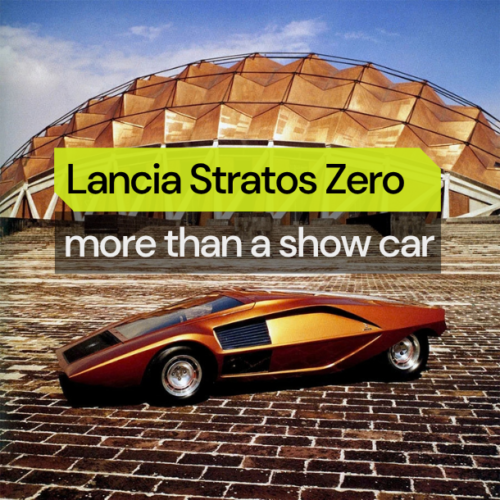
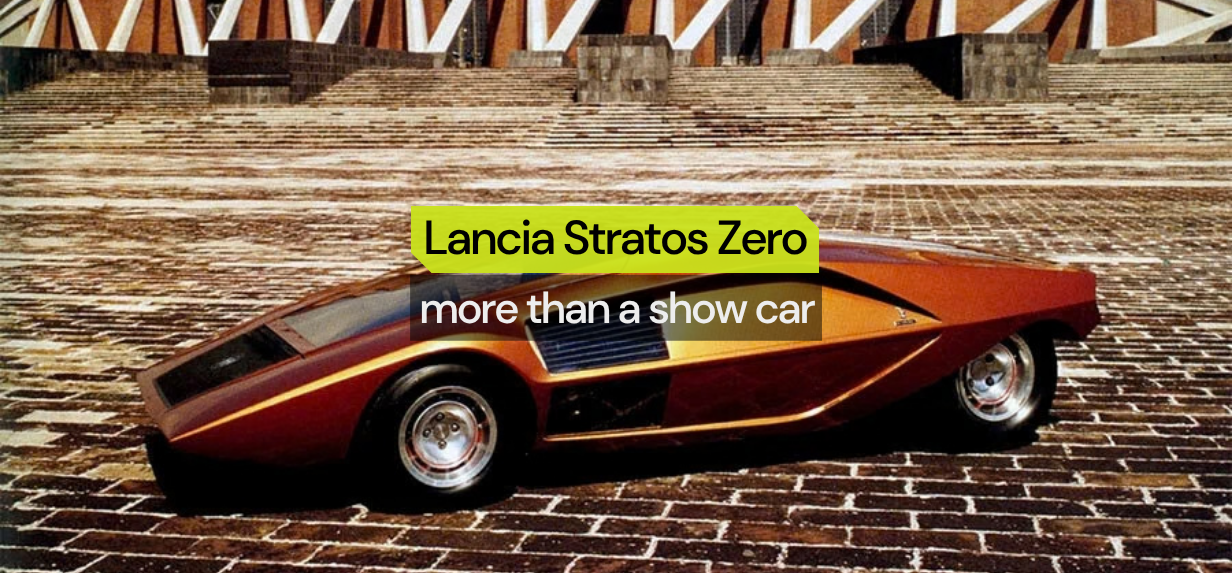
Lancia Stratos Zero: more than a show car
In the history of concept cars, there is no shortage of models created to capture attention at a motor show and then quietly disappear. The Lancia Stratos Zero belongs to a different category. It is not just a styling exercise or a design provocation. It is a car that introduced a new direction, not only for Lancia, but for automotive design as a whole at the turn of the 1970s.
Presented at the 1970 Turin Motor Show, this one-off creation by Bertone remains one of the clearest examples of a car whose architecture was far ahead of the conventions of its time.
Gandini and Bertone
The Stratos Zero was designed by Marcello Gandini while working at Bertone. His work is defined by clear geometric logic, restrained proportions, and forms built from simple lines and surfaces rather than decorative details.
The Stratos Zero pushed that approach to its limit. It stands as one of the clearest examples of the so-called wedge era, an early and highly distilled version of angular automotive design.
Proportion and layout
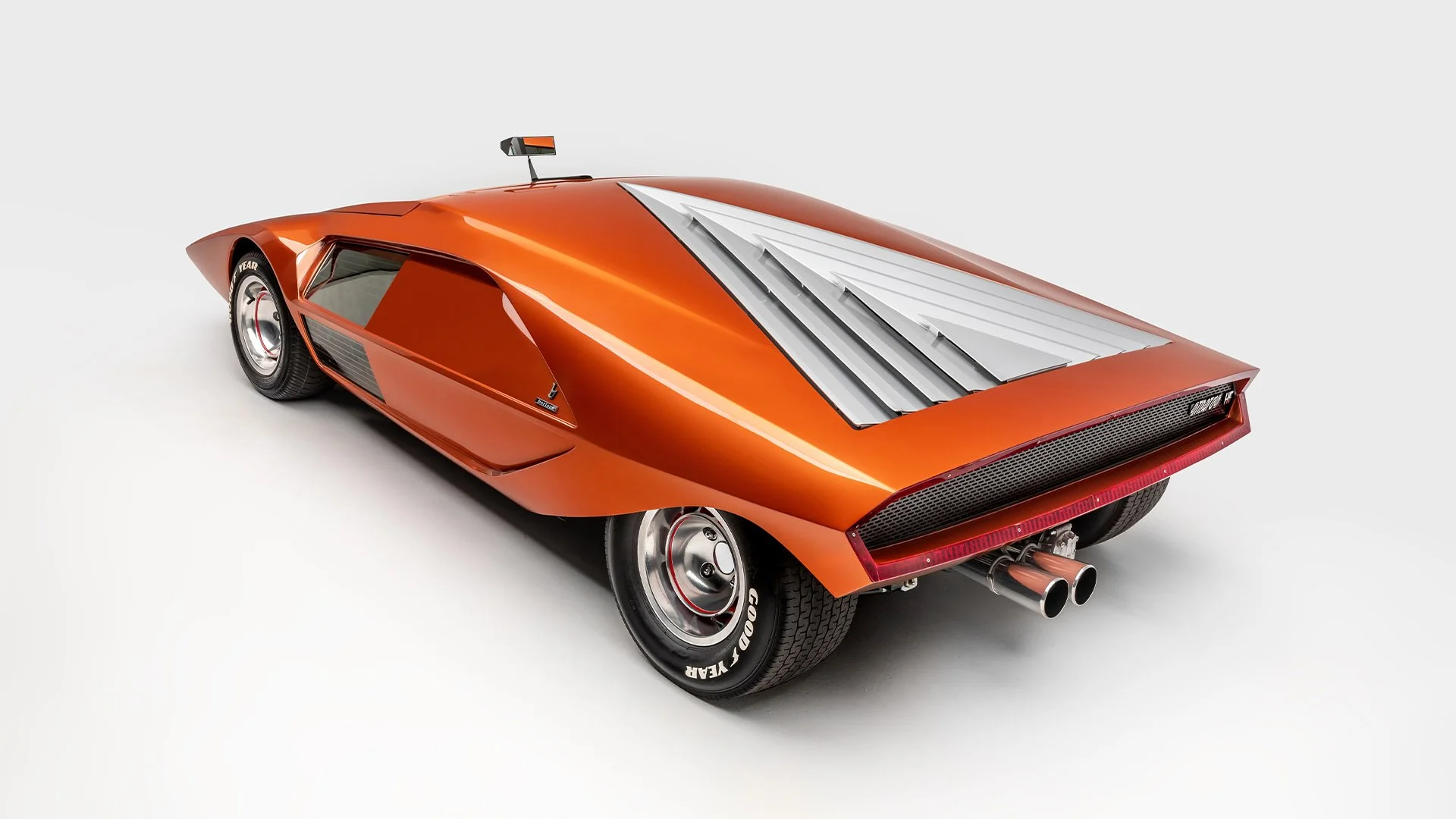
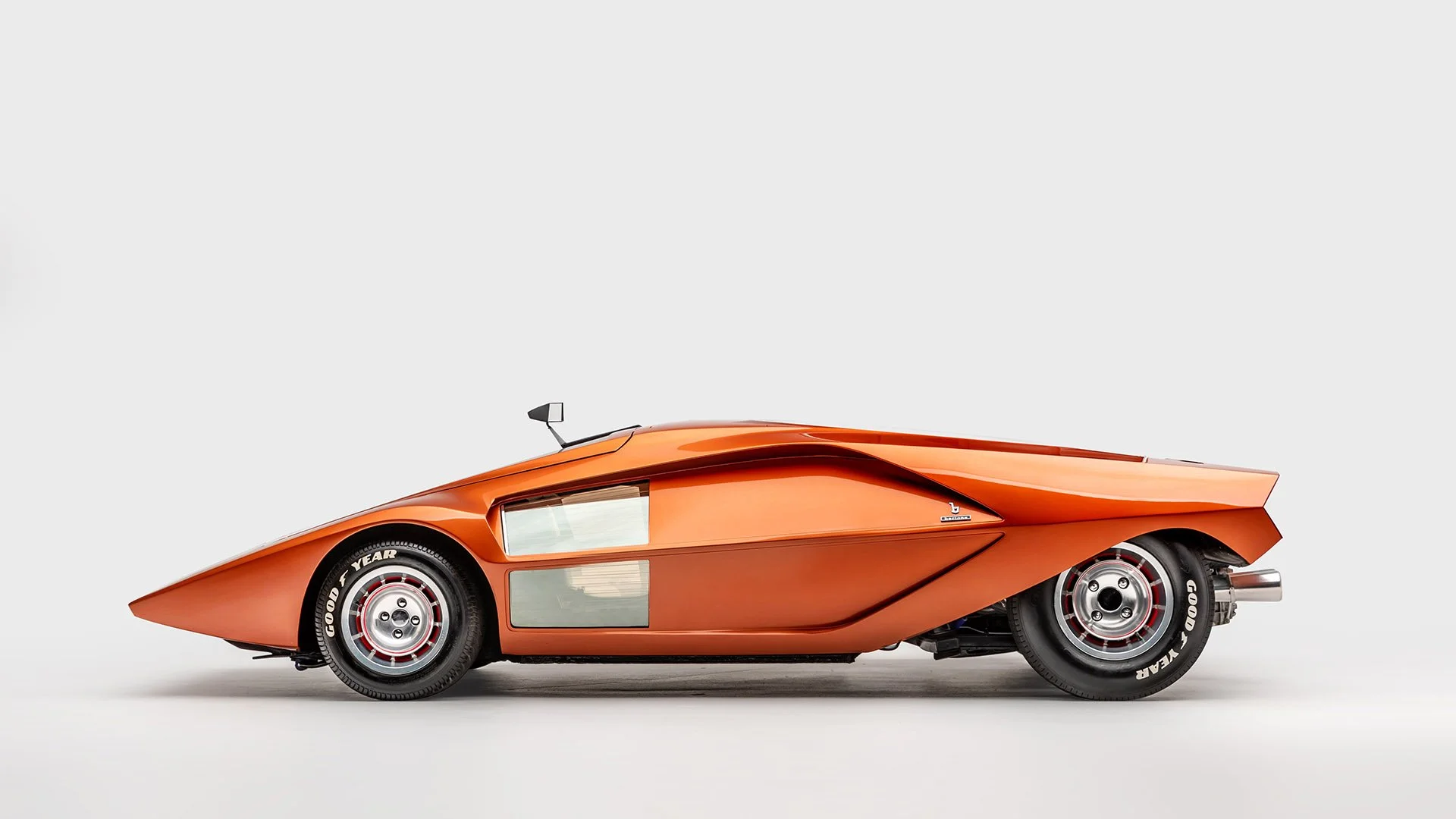
Even more than fifty years later, the Stratos Zero still looks unusual. At just 84.6 cm tall, its body sits almost flat against the ground, stretched forward and almost entirely free of vertical surfaces. Power is not the main point here. A height like this changes the entire layout of the car: the driver’s position, the shape of the front end, and the issue of visibility. The Stratos Zero does not fit into the usual category of a low car. Here, height becomes the central engineering decision.
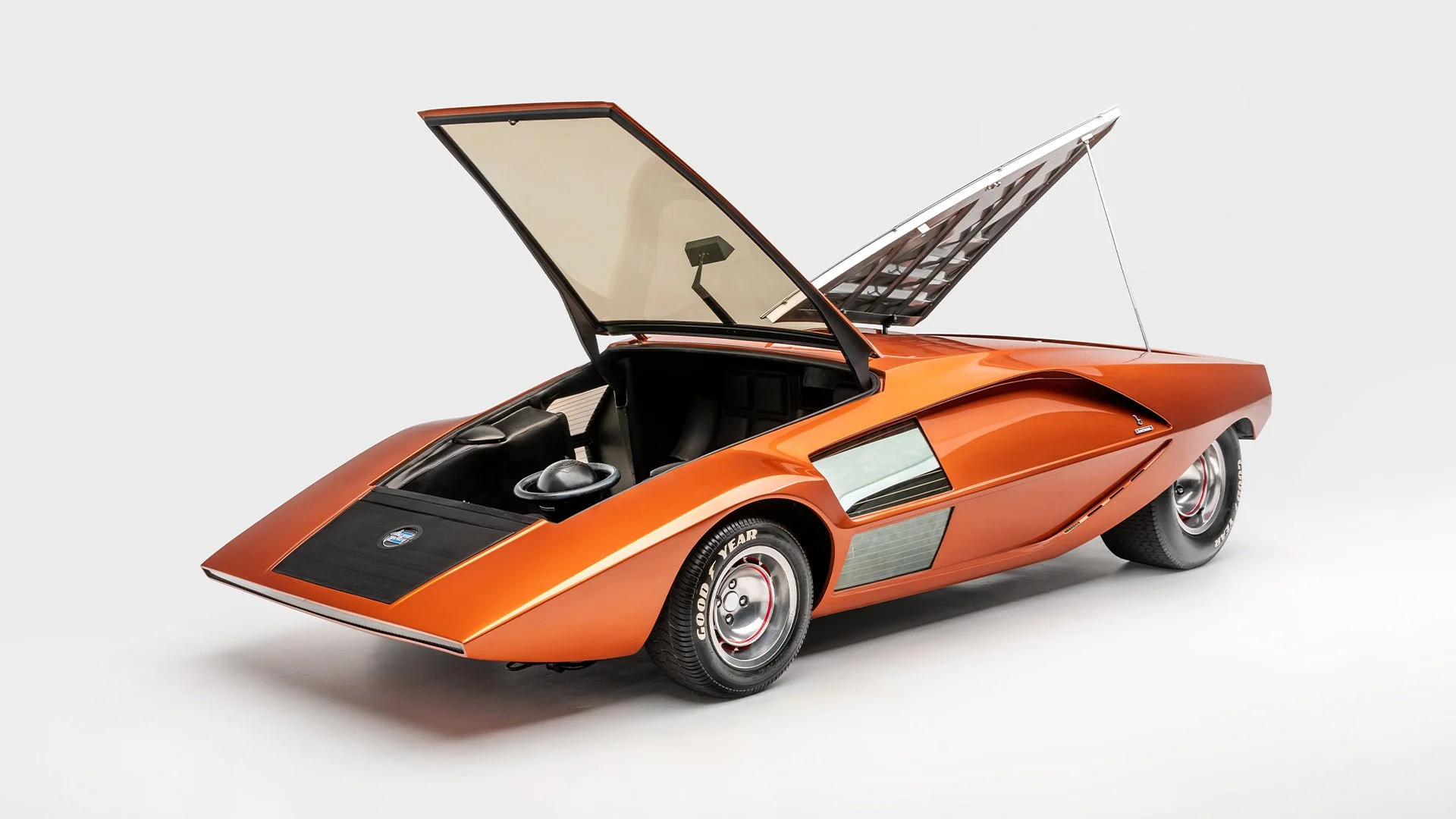
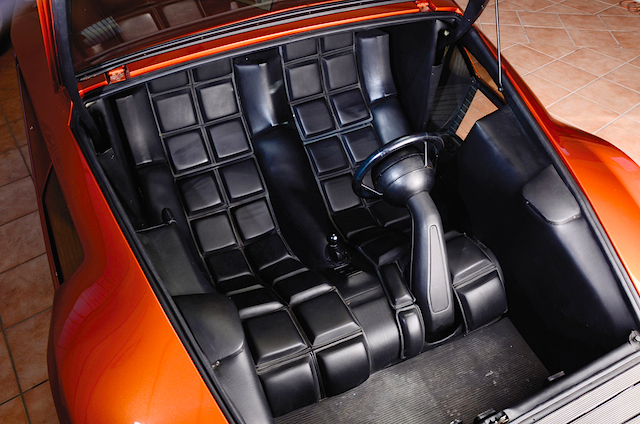
For that reason, the Stratos Zero was not developed according to the conventional sports car formula. The main elements are arranged differently. Traditional doors lose their function, so access to the cabin comes by lifting the windscreen section. The engine is mounted in the middle, the body wraps tightly around the mechanical package, and the entire silhouette takes on a wedge shape. This is not a stylistic trick. That layout made it possible to lower the front end to a level that was highly unusual for road cars at the time.
The link to the Lancia Stratos
The Stratos Zero was not a one-off idea with no continuation. Although it differs from the production Lancia Stratos, it was from this car that the Stratos concept began. Later, the Stratos name would be given to a completely different machine, one built for rallying and one that became one of the defining sports cars of its era. The two are not the same, but they share the same starting point.
When people speak about the Stratos name, they usually mean the rally car with the Ferrari Dino V6, a short wheelbase, and a clear competition purpose. The Stratos Zero came before that. It was a design experiment, not a competition car. Only later was that idea adapted for rally use. For that reason, the Zero should not be seen as an early version of the Stratos in the narrow sense, but as the original project from which the Stratos story began.
Its place among other cars
The Stratos Zero appeared at a moment when the shape of the car itself was changing.
During the 1970s and 1980s, low, angular cars with forward-driven silhouettes became increasingly common. The Zero was one of the earlier examples. Later, these solutions became familiar across the industry.
Its value today
The Stratos Zero is a one-off, running prototype, created not for mass production but as an experiment. Cars like this are not valued only for their technical data. Their origin, authorship, and place in a manufacturer’s history matter just as much. The Stratos Zero has a clear connection to the Bertone studio, to Marcello Gandini, and to the later Stratos models.
In the case of the Lancia Stratos Zero, the point is not power or specification. Everything is defined by proportion. The driver’s position is changed, the entry method is rethought, the mechanics are rearranged, and the body takes on a completely different form. This is not simply a late-1960s experiment, but a project in which design moved beyond the accepted solutions of its time. Later, that same logic would be picked up by other car designers as well.